

Guides Safety
How to Burn and Care for a Candle: A Guide for Candle Lovers
How to get the most from a candle safely: the first burn, trimming the wick, where to burn it, putting it out, fixing tunneling and smoke, storing it, and a care card for makers.

A well-made candle can burn evenly for many hours and fill a room with scent. The same candle, burned badly, can tunnel down the middle, smoke, or turn a glass jar dangerously hot. The difference is mostly how you burn it, and it takes about a minute of care each time.
This guide is for anyone who burns candles, and it is written so a candle maker can share it with customers, or turn the last section into a care card. It covers the first burn, trimming the wick, where to put a candle, how to put it out, what to do about the common problems, and how to store a candle. If you make candles, it pairs with Candle Safety and Burn Testing and Curing.
The first burn matters most
A candle remembers its first burn. If the melted wax never reaches the edge of the container the first time, it tends to burn down in a narrow tunnel from then on, and the wax around the edge is wasted.
So on the first burn, let the candle burn long enough for the melted pool to reach the edge of the container. A common rule of thumb is about one hour for every inch of container width, but never more than about four hours at a stretch. Treat it as a guide, and follow your candle maker’s directions if they differ. If you cannot stay with the candle that long, light it when you can watch it, and let the pool reach the edge another day, starting from a fresh trim.
A safe burn, step by step
1. Trim the wick
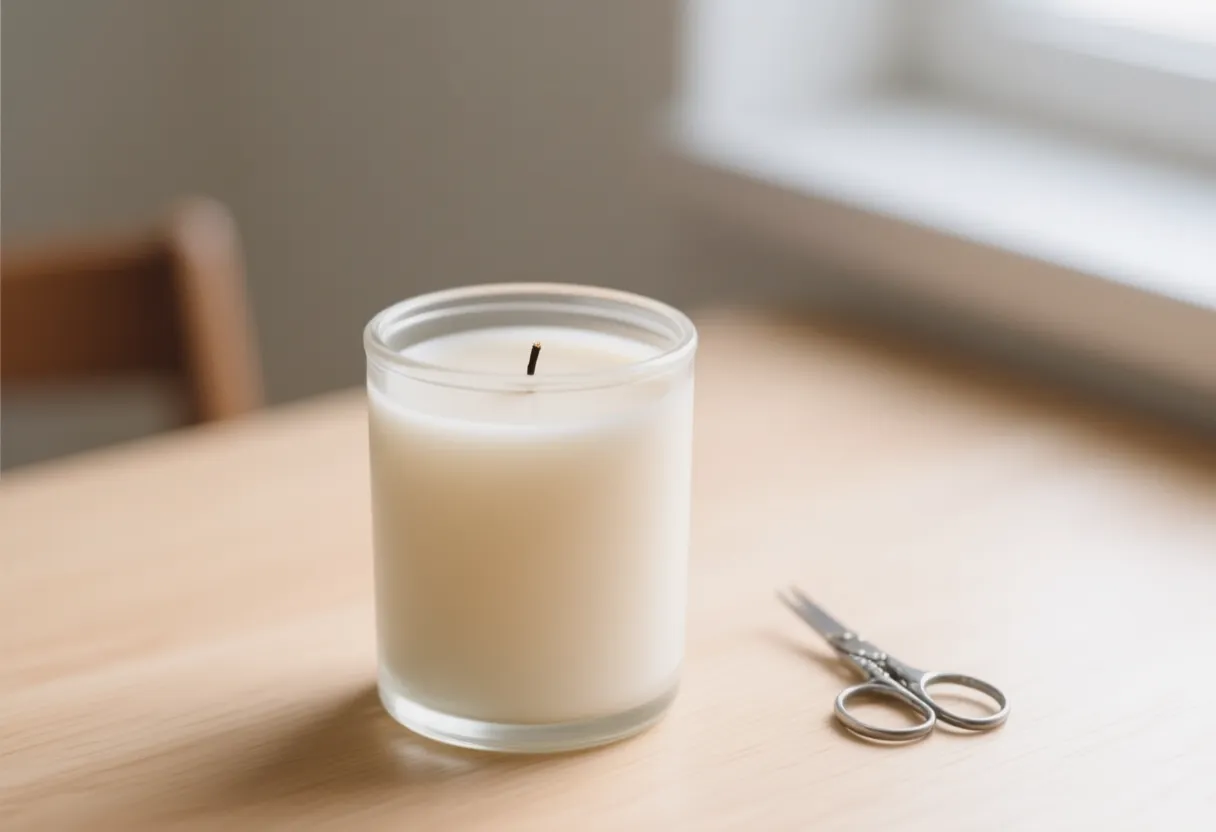
Before every burn, put the candle out if it is lit, let it cool, and trim the wick to about ¼ inch. Remove any bits of wick or ash from the wax. A long or crooked wick makes a tall, sooty, flickering flame. A short, tidy one burns cleanly.
2. Choose the spot
- A level, heat-resistant surface, not the edge of a shelf, and not a surface that can scorch.
- Away from drafts, open windows, fans and vents, which make the flame flicker and burn unevenly.
- Away from anything flammable: curtains, paper, decorations, books, bedding and plants.
- Out of reach of children and pets.
- Not under a shelf or cupboard, where the heat rises.
3. Light it
Use a long lighter or a match, and keep hair, loose sleeves and anything dangling out of the way. Light the wick and let the flame settle.
4. Watch it burn
Stay in the room, and glance at the candle often. A good flame is steady and calm. Look at the container: glass will get hot, and you should be able to see melted wax spreading toward the edge. If the flame grows tall, flickers wildly or smokes, put it out and trim the wick before relighting.
5. Put it out
Use a snuffer or put a lid on the candle. This avoids splashing hot wax and sending smoke into the room. Never use water on a candle. Let the candle cool completely before you move it, touch the glass or relight.
6. Burn it down sensibly
Stop using a candle when about ½ inch of wax is left at the bottom, because a flame that close to the base can overheat the container. When it is finished, let it cool completely before you handle it.
Do and never
If something looks wrong
Most candle problems have a simple cause. If one keeps happening, or you are worried, put the candle out and contact the person who made it. Do not keep burning a candle you are unsure about.
| What you see | What it usually means | What to do |
|---|---|---|
| Wax burned down the middle, thick ring left at the edge (tunneling) | The first burns were too short, or the wick is too small | Burn longer next time, until the pool reaches the edge. If it keeps happening, tell your maker |
| Black smoke or soot on the glass | The wick is too long, or a draft is bending the flame | Put it out, let it cool, trim the wick and move it out of the draft |
| A tall, flickering flame | Wick too long, a draft, or a wick that is too big | Put it out, trim, and move it. Tell your maker if it continues |
| A dark lump on the wick tip (mushrooming) | Carbon is building up | Put it out, let it cool and trim the wick |
| The flame drowns in melted wax and goes out | The wick is too small, or wax is pooling around it | Put it out, let it cool, trim and relight. Tell your maker if it repeats |
| Weak scent | The candle has not burned long enough for a full melt pool, or the scent is mild | Burn it long enough for the pool to reach the edge, in a room without drafts |
| White frosting or patches where the wax pulls from the glass | A natural look in some waxes, and it does not affect the burn | Cosmetic only |
| A cracked jar, or a very hot container | Possible container damage, or a wick that is too big | Put the candle out and stop using it. Do not move it until it is completely cool |
For more on how wicks and wax cause these, see Candle Troubleshooting.
Store it well

- Keep the lid on when you are not burning it, to keep out dust and keep the scent in.
- Store candles somewhere cool, dry and out of direct sun. Heat and sunlight can soften wax and fade color and scent.
- Do not leave candles in a hot car or by a heater.
- Keep them away from children and pets, and out of reach.
- Do not store things on top of a candle, and do not stack heavy items against the glass.
Scent, sensitivity and ventilation
- Burn candles in a room with fresh air.
- If a scent bothers you or causes a headache, irritation or any other reaction, put the candle out and stop using it. People differ in what they tolerate.
- Keep scented candles away from pets and small children, and do not let anyone eat or drink from a candle or its container.
- If you are sensitive to fragrance, ask the maker what is in the candle before you buy.
When a candle is finished
Stop at about ½ inch of wax, and let the candle cool completely. Do not reuse a candle jar as a drinking glass or a food container. If you want to reuse a jar for something else, ask your maker how to clean it safely, and never heat glass sharply.
A care card for makers
If you make candles, a short card in the box helps your customers burn them safely and shows you take care. Adapt this to your own tested directions, and never print a number you have not tested.
Burn it well. 1. Trim the wick to about ¼ inch before every burn. 2. For the first burn, let the melted wax reach the edge of the container. Never burn it for more than about four hours at a stretch. 3. Burn on a level, heat-resistant surface, away from drafts and anything that can burn. 4. Keep it in sight. Keep it away from children and pets. 5. Put it out with a snuffer or lid, and let it cool. 6. Stop when about ½ inch of wax remains. Questions or problems? Get in touch with us.
Put the safety warning on the candle as well. See Candle Labels and Compliance Basics.
Common questions
Why does my candle tunnel?
Usually because the first burns were too short, so the wax never melted to the edge. Burn it long enough for a full pool next time. If it still tunnels, tell the maker, because the wick may be too small for the container.
Should I blow a candle out?
A snuffer or a lid is better. Blowing can splash hot wax and send smoke into the room.
How long should I burn a candle?
Long enough for the melted wax to reach the edge, and never more than about four hours at a stretch. Follow the maker’s directions if they differ.
Can I trim the wick while the candle is lit?
No. Put it out, let it cool, and then trim.
Is it safe to leave a candle burning while I sleep or go out?
No. Never leave a burning candle unattended. Put it out before you leave the room or go to bed.
Why is my candle jar so hot?
Glass holds heat. If it is too hot to touch lightly, or very hot near the end of the candle, put it out, let it cool, and stop using it when about ½ inch of wax is left. If a candle gets extremely hot early on, tell your maker.
Where to go next
- Candle Safety for the full set of safety habits.
- Candle Troubleshooting for what causes each problem.
- Burn Testing and Curing for how makers prove a candle.
- Candle Troubleshooter to work out what is wrong with a candle.
- Shipping and Packaging Candles for what to put in the box.
Questions or corrections? Send a note. Ready for the next step?Browse more guides.