Guides Start Here
Candle Math Explained: Weights, Percentages, Volume and Yield
The arithmetic behind a candle batch: ounces and grams, jar volume to wax weight, fragrance load as a percentage, scaling a batch, burn rate, and the mistakes to avoid.
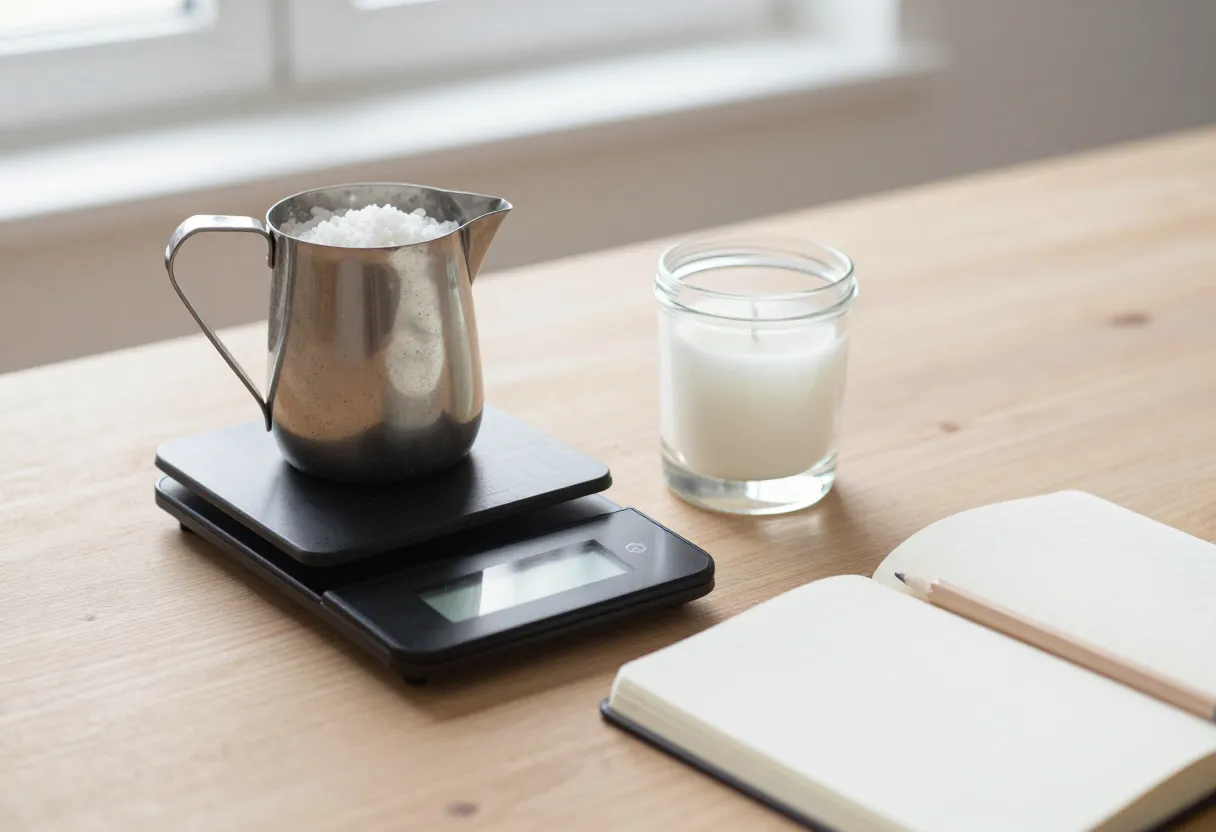
Candle making looks like a craft, and it is, but under the craft there is a little arithmetic that decides whether a batch works. How much wax fills this jar? How much fragrance goes in? How much do I need for twelve? How long will it last? None of it is hard. It is mostly multiplication, and the mistakes people make come from mixing up units, not from the math.
This guide walks through the calculations behind a candle batch, with one worked example from start to finish, so you can see how the numbers connect. Every calculation here has a free calculator on this site, so you can check your own work. Read it alongside Your First Candle.
Three kinds of ounce
The most common mistake in candle math is mixing up units. There are three things that get called an ounce.
| Unit | What it measures | Example |
|---|---|---|
| Ounce (oz) | Weight | An ounce of fragrance oil, or a pound of wax (16 oz) |
| Fluid ounce (fl oz) | Volume, the space something fills | A jar that holds 8 fl oz |
| Ounce on a container label | Usually capacity, sometimes weight | An “8 oz jar” usually means 8 fl oz of capacity. Check the supplier |
A jar marked “8 oz” usually holds 8 fluid ounces, but it does not hold 8 ounces of wax by weight. Wax is lighter than water, so a jar’s wax weight is less than its fluid ounces. That is why you cannot buy wax by the “oz of jar” and expect it to match.
A few conversions to keep handy:
- 1 ounce is about 28.35 grams.
- 1 pound is 16 ounces, about 453.6 grams.
- 1 fluid ounce is about 29.57 milliliters.
The Unit Converter does these, and temperatures and lengths too. Work in grams whenever you can. Grams are finer, and a gram scale is far more accurate for fragrance than ounces.
From jar to grams of wax
You want to know how much wax a jar takes. The calculation uses three numbers: the jar’s volume, how full you will fill it, and how dense the wax is.
Step 1: the volume
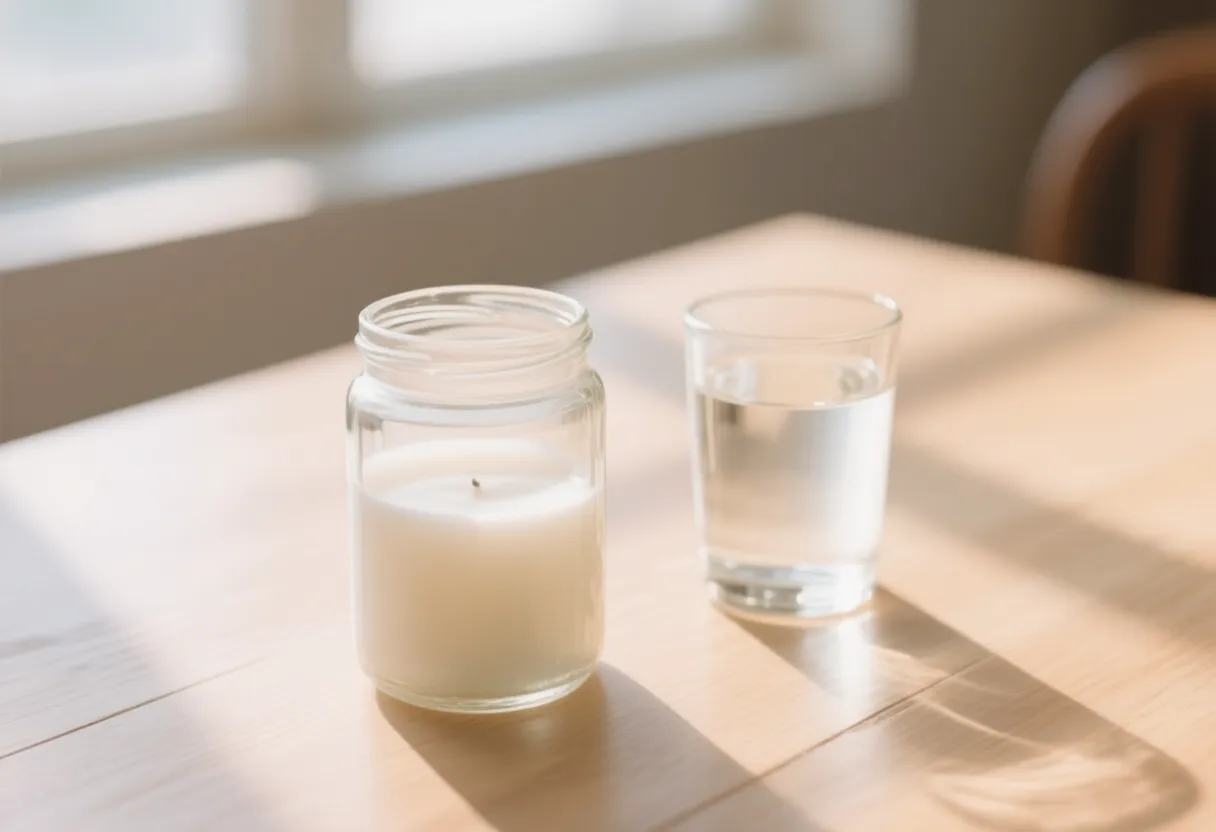
Find out how much the jar really holds. Your supplier’s figure is a good start, but the surest way is to fill the empty jar with water to the level you will fill the candle to, and measure that water. Convert fluid ounces to milliliters (1 fl oz is about 29.57 ml).
Step 2: the fill level
You do not fill a jar to the brim. Leave room at the top, and allow for the container’s shape. Fill level is the share of the full volume you will pour, such as 85 or 90 percent. The Wax Calculator lets you set it. The right level depends on the container, so measure it on a real jar.
Step 3: the density
Wax is lighter than water. The Wax Calculator uses estimated densities relative to water: about 0.86 for soy, 0.88 for coconut blends, 0.90 for paraffin and 0.96 for beeswax. These are estimates. Blends and additives change them, so a wax’s real figure can differ, and you should check it on a real pour.
Step 4: multiply
Wax weight (g) = volume (ml) × fill × density
A worked example, with a jar that holds 8 fl oz, filled 85 percent, with soy wax:
- Volume: 8 fl oz × 29.57 = about 236.6 ml
- Filled: 236.6 × 0.85 = about 201.1 ml
- Wax: 201.1 × 0.86 = about 173 grams (6.1 oz)
That is the number the Wax Calculator gives for those inputs. Treat it as an estimate. Pour one jar, weigh the wax, and use the real weight from then on.
Fragrance load is a percentage of the wax
Fragrance load is the weight of fragrance oil as a percentage of the weight of the wax. It is the single most misunderstood number in candle making.
Fragrance weight (g) = wax weight (g) × load
Continuing the example, with an 8 percent load:
- 173 g × 0.08 = 13.8 grams of fragrance
- Total in the pitcher: 173 + 13.8 = about 187 grams
Two common mistakes:
- Taking the percentage of the total. The load is a share of the wax, not of the wax plus fragrance. If you work out 8 percent of the total instead, you will use a bit too little.
- Going over the limit. Your wax has a maximum load, given by its supplier. Never go above it. The Fragrance Load Calculator warns you if you do, and the Pour and Cure Guide lists suppliers’ figures.
If you blend more than one oil, the load applies to the total of all of them. The Scent Blend Calculator splits the total by parts.
Scale up to a batch
To make many candles, multiply. The calculation uses the number of candles, plus a little extra for waste and top-ups.
Batch wax = one candle’s wax × number of candles × (1 + extra)
- 173 g × 12 candles = 2,075 grams
- Add 10 percent extra for spills, a second pour and what sticks to the pot: 2,075 × 1.10 = about 2,283 grams, which is about 5 pounds
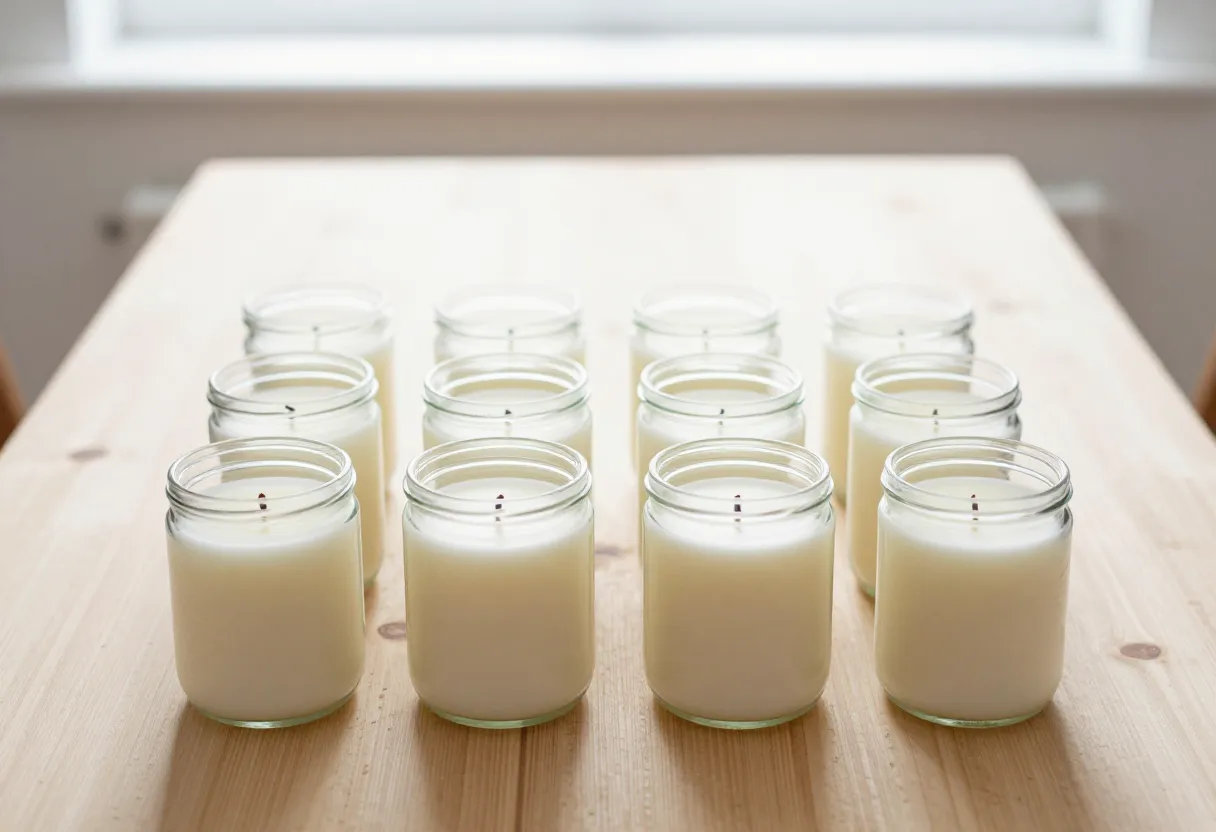
The fragrance scales the same way: 13.8 g × 12 = about 166 grams, and the same ratio for everything else. The Batch Scaler scales every ingredient at once, from any starting recipe. Remember that a bigger batch behaves differently from a small one, so test each step up. See Candle Workshop Setup and Small-Batch Production.
How long will it burn?
Burn time starts from a measurement. Burn a candle for a measured time, weigh it before and after, and divide.
Burn rate (g/hour) = grams burned ÷ hours burned
Suppose a candle loses 30 grams in 4 hours. That is 30 ÷ 4 = 7.5 grams per hour.
Then, to estimate how long a candle will last, divide the usable wax by the burn rate. You do not burn all of it, so leave out the wax left at the bottom.
Burn time (hours) = usable wax ÷ burn rate
With 173 g of wax and about 10 percent left unburned, the usable wax is about 156 g, and 156 ÷ 7.5 is about 21 hours. The Burn Rate and Burn Time calculator does both steps. It is an estimate based on your own test, so do not print it as a promise on the label. See Burn Testing and Curing.
The four calculations at a glance
Cost per candle
Once you know your weights, you can work out what a candle costs. Add up the wax (price per pound times pounds), the fragrance, the wick, the container, the label, the packaging and your time. Then work out a price that covers fees and profit as well. The Cost and Pricing Calculator does the sums, and Selling Candles explains the thinking.
Mistakes that cause trouble
| Mistake | What goes wrong | The fix |
|---|---|---|
| Treating “8 oz jar” as 8 oz of wax | Too much or too little wax | Work from volume, density and fill, then weigh a real jar |
| Measuring fragrance by the teaspoon or by drops | Inconsistent scent | Weigh every oil, in grams |
| Taking load as a percentage of the total | Less fragrance than planned | Multiply the wax weight by the load |
| Forgetting extra for waste | Running short of wax mid-batch | Add an allowance for the pot and a second pour |
| Rounding too early | Errors that add up across a batch | Keep decimals until the final answer |
| Trusting a calculated weight without checking | An overfilled or underfilled jar | Pour and weigh one jar first |
| Mixing grams and ounces in one recipe | A badly wrong amount | Pick one unit and stay with it |
Write the numbers down
A calculation is only useful if you keep it. Write the volume, the fill, the density you used, the wax weight, the fragrance weight and the total in your batch record, along with the weights you actually measured. The Burn Test Log keeps recipes and test results in your browser.
Common questions
Why work in grams and not ounces?
Grams are smaller, so a scale reads finer, and metric math is simpler. Fragrance amounts are small, and a gram scale gives you the precision you need.
How accurate is the wax weight from the calculator?
It is a good estimate, because the density of a wax varies with its blend. Weigh the real wax in a real jar and use that number.
Is the load based on the wax only?
Yes. It is the fragrance weight divided by the wax weight, and does not include the wick, container or dye.
How much extra should I allow?
Ten percent is a sensible starting point for a batch. If you find you always have wax left over, or always run short, change it.
How do I scale a recipe for a different jar?
Work out the wax for the new jar from its volume, fill and density, then work out the fragrance as the same percentage of the new wax weight. Retest the wick, because a new container is a new recipe.
Do I include dye in the weight?
Dye is a small amount. Follow your supplier’s guidance on how much to use, and record what you used.
Where to go next
- Wax Calculator for wax weight from a jar.
- Fragrance Load Calculator for oil weight and the load limit.
- Batch Scaler to scale a recipe.
- Burn Rate and Burn Time for how long a candle lasts.
- Unit Converter for any unit.
- Candle Fragrance Explained for the thinking behind the load.
Questions or corrections? Send a note. Ready for the next step?Browse more guides.